‘One Battle After Another’ used the dramatic setting of California’s La Purisima Mission, but the location has a much more radical history
By Joe Payne
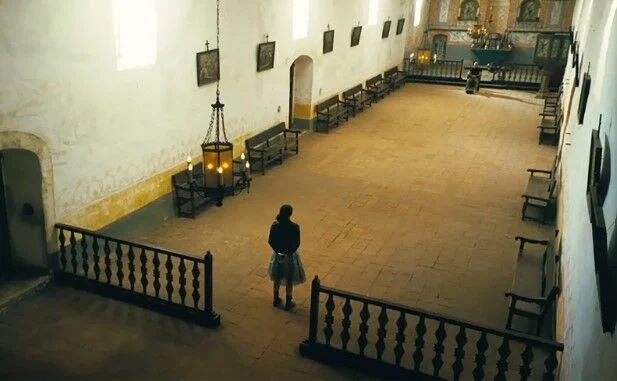
In Paul Thomas Anderson’s Academy Award-winning “One Battle After Another,” Sean Penn’s villainous Lockjaw corners Chase Infiniti’s Willa in the chapel of a rural convent that gave her safe harbor. The dramatic setting helps trigger the heart-pounding third act of the film, which portrays a disjointed leftist radical cell in its attempts to escape the machinations of an eerily prescient neofascist American police state.
The actual location of the harrowing scene, however, was no nondescript rural soCal sanctuary, as the film implies, but rather La Purisima Mission State Historic Park on California’s Central Coast. Tucked alongside rolling hills of California wine country where they meet fertile fields of vegetable agriculture, the mission site has a radical history of truly revolutionary resistance beyond the imagination of Hollywood.
One of the twenty-one Spanish missions that proved pivotal in the colonization of California, La Purisima sits near present-day Lompoc, a short drive from missions Santa Ines and Santa Barbara, both of which give their names to the cities that surround them. In 1824, the Indigenous Chumash held in bondage at these three missions led the largest revolutionary uprising in California Mission History. La Purisima was the one mission of the three that the Chumash occupied for a month, fortified, and fought a battle to defend against the colonial Mexican military.
Fact versus facade
The La Purisima Mission building that stands today at the State Historic Park and served as set piece in “One Battle After Another” is not the same adobe-brick construction that the Chumash fired arrows and musket balls from in 1824.
The original was a heap of rubble a century ago before the Civilian Conservation Corps transformed it in the then-largest historic preservation project in California history during FDR’s “Great Works” of the late 1930s. It’s a standing representation of the figurative and literal whitewashing of California mission history, which transformed a legacy of forced labor and genocide into a romanticized icon of Spanish colonialism.
Generations of Californians were taught about the missions as fourth graders, where styrofoam and sugarcube models were melded with a pastiche of friendly Franciscans and nearly-invisible Indigenous Californians. The reality of the California Mission system was far from pious, however, as the missions served as an important tool for the late 18th Century military incursion into Indigenous lands dubbed Alta California.
Missions were far-flung frontier outposts of agrarian production that fed and clothed the Spanish colonial military and settlers by the hands of the Indigenous Californians. Missions were established with a military presence alongside the priests, who coaxed and coerced Indigenous Californians to the missions through various means. Once baptized by the Franciscan padres, Indigenous peoples were bonded to the Mission in a feudal form of forced labor and Christian social control, enforced at rifle-point by abusive colonial soldiers.
Today, Indigenous Californians say the Mission system was a form of slavery. Indigenous historian and activist Edward Castillo argued that the combination of population concentration at the missions and communicable diseases from Europeans amounted to a “biological Holocaust” on the Indigenous population.
An accurate account of this history leaves no mystery as to why the Chumash took radical and militant action against the Mission system and those that imposed it on them.
Battle after battle
Historians have only recently defined the conflict that began in February of 1824 at Missions La Purisima, Santa Ines, and Santa Barbara as a revolutionary war–the Chumash War of 1824. Dismissed for generations as a small uprising, the conflict began in the context of continual Indigenous population loss from disease, stresses on mission laborers to produce more goods, and the radical period of the Mexican War for Independence.
The war lasted the better part of a year, but began when a prison guard (yes, there were prisons at the missions) at Mission Santa Ines ordered the whipping of a young Chumash man for an insolent remark. What the Chumash did next, and the level to which their response spread across the three missions, suggests that this instance of corporal punishment triggered a plan that was already well prepared.
Within minutes the Chumash at Mission Santa Ines rained clouds of arrows onto the soldiers, who fired their rifles in retaliation. A handful of Chumash and a Mexican soldier were killed before the soldiers barricaded themselves in the sacristy with the mission’s lone priest. The Chumash, unable to reach their targets holed up behind the adobe bricks laid by their own hands, then set Mission Santa Ines on fire before emancipating themselves and fleeing the mission complex.
Hundreds of Chumash lived at each of the three missions, and within a day the mass mobilization spread to the neighboring missions into a full-scale revolution.
At Santa Barbara, the Chumash snatched the rifles from the hands of the soldiers stationed at the mission, allowing them to escape to the Presidio Santa Barbara, the fort and barracks a short mile away that housed the military stationed at the nearby missions. A troop of Presidio soldiers returned to the mission where the Chumash were waiting, armed with the stolen rifles and bows and arrows. A battle waged for hours, with the missionized Chumash holding Mission Santa Barbara before the Presidio soldiers retreated. The Indigenous revolutionaries then abandoned the mission for the mountains, removing their productive labor and as many prepared goods and livestock as they could bring with them.
Mission La Purisima was where hundreds of the escaped Chumash converged, joining forces with those there who had deposed the mission soldiers and padres, holding them captive. The occupation of La Purisima had begun.
The occupation of Mission La Purisima is significant. It stands as the most radical subversion of the California Mission system throughout its history–there was no other time or place where Indigenous Californians overthrew Mission authorities and claimed the mission along with its lands, livestock, and goods for their own.
During the occupation, the liberated Chumash used their labor and skills for their own defense, fortifying the mission to more resemble the Presidio fort near Mission Santa Barbara in preparation for the battle they knew was on the horizon. The Mission bell that usually marked the beginning of their days of forced labor and Christian worship was now a siren to warn of approaching colonial counterrevolutionaries.
The local Mexican military was caught completely off guard by their collective resistance, unable to deal with the scale of militant organization of the revolutionary Chumash. A pardon was floated in the early days of the occupation at La Purisima by the Presidio commander, but the request to lay down their arms went ignored by the Chumash.
The Governor of Alta California intervened, dispatching a battalion of one hundred soldiers armed with rifles and a four-pound cannon from Presidio Monterey two hundred miles to the north to end the occupation. It took weeks for the battalion to arrive, stopping at Mission San Luis Obispo on the way. A report from the deployment suggests that some Chumash escaped from that mission right under the padres’ noses, warning the Chumash at Purisima and possibly swelling their numbers berfore the coming battle.
The revolutionary Chumash at La Purisima had not been idle in their occupation, hardening the mission buildings for battle. But they also dispatched emissaries to the southern San Joaquin Valley to Yokut territory, calling on their Indigenous neighbors to join their revolution and give safe harbor to the Chumash noncombatants who fled to the Central Valley.
The battalion sent from Monterey finally made its way to La Purisima Mission in the morning hours of March 16, 1824, nearly a month after the Chumash took control of the mission. The soldiers made a slow advance, peppering the entrenched Chumash with their dozens of rifles versus the six guns the revolutionaries had acquired.
The Chumash were outgunned but not outnumbered, at least four hundred Chumash fought for hours from their fortified position. The Indigenous revolutionaries suffered dozens of casualties as the riflemen were able to push forward, bringing the four-pound cannon into range.
Ultimately, sixteen Chumash died in the battle that day while many more were injured before their last remaining hostage, the Franciscan missionary of La Purisima, appeared waving a token of surrender.
Revolutionary legacy
The Chumash War did not end after the Battle of La Purisima, though the counterrevolutionary efforts of the Mexican military ramped up, including the incarceration of the revolution’s leaders and firing squad executions.
Hundreds of Chumash had already fled inland, and continued the exodus to the Southern San Joaquin Valley near present-day Bakersfield. The Chumash who were returned to the missions following the battle continued to self-emancipate from the missions, hopping on horseback to join their brethren who had set up camp near Buena Vista Lake, southwest of present-day Bakersfield.
A small military expedition sent after the Chumash was met with skirmishes at interior ranchos, finding the lakeside maroon colony impossible to assault. The Governor of Alta California had to dispatch yet another expedition from the bay area to the interior of the territory to return the escaped Chumash to the coastal missions and their status quo of forced labor. The expedition didn’t arrive until June of 1824.
The Chumash had proved themselves in their radical, militant uprising against the settler-colonial state, and were approached both with diplomacy and the implied threat of force. Two Franciscan padres joined the soldiers to parlay with the Chumash, offering a pardon signed by the governor should they return.
The summit to return the Chumash to the missions included an airing of grievances and days of negotiation. The Franciscan missionaries and the Mexican soldiers played good cop, bad cop with the Chumash, appealing to their newfound Christian faith and outright threatening violent retribution.
Though most of the Chumash were returned to the missions, evidence suggests that hundreds of Chumash fled even further into the interior of California to never return.
Within a decade of the conflict, which included another smaller-scale Indigenous uprising in the bay area missions in 1828, the California missions were formally secularized by the Mexican government. A decrepit and failing institution, the California missions were destabilized by the Chumash in 1824 in one of their most economically productive and picturesque locations on the Central Coast. The Chumash undoubtedly helped spur the end of the California Mission system.
Mission Santa Barbara is still referred to as the “Queen of the Missions” by the Franciscans, who never let go of the site, maintaining it and an archive of California mission documents, including those that help illustrate this long-downplayed history. The Franciscans have also carefully curated the historical perspective of the California Mission system from that archive, contributing to the legacy of romanticization, spinning or dismissing the radical uprising that occurred in 1824.
The result has been that the California Missions fade into the background of the state’s history, present in the aesthetic of Spanish tile and adobe arches along with a perspective frozen in a fourth grade understanding. California Missions are emblazoned across postcards and murals, or used as the backdrop of faux-radical Hollywood movies, all of which ignore or obscure the revolutionary truth hidden in the history.
Joe Payne is an award-winning independent journalist and historical scholar from California whose recently-published Master Thesis in History explores the Chumash War of 1824. Read it here: https://digitalcommons.calpoly.edu/theses/3073/ or visit https://politicalpayne.com/ to learn more.

Donate!
Your donation can help me provide independent journalism covering local, national, and worldwide news along with the analysis and commentary you trust me to provide.
$5.00
 Political Payne